
Technical guide · Technical Resources
How to Read PVA Filament Codes: D, dtex and F
A PVA filament code combines a linear-density field with a filament-count field. This guide separates those meanings, shows when a D-to-dtex conversion is useful, and explains how to keep the catalog identifier attached to the sample, test method, and purchase record.
Read the two parts of a filament code separately
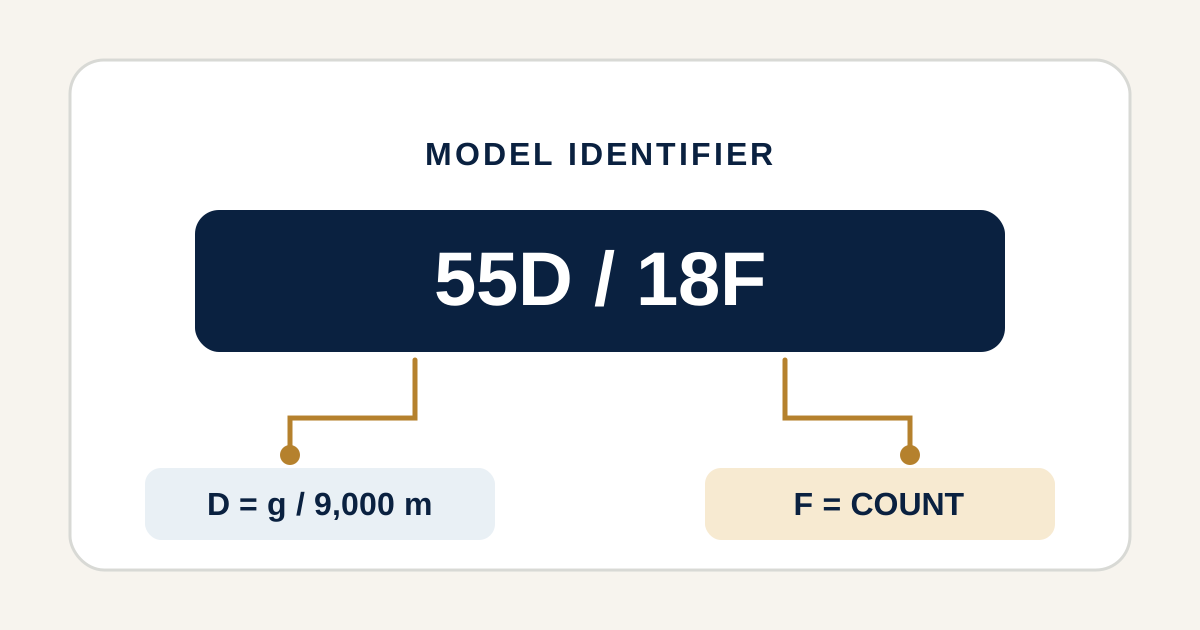
A PVA filament code such as 55D/18F combines a linear-density field and a filament-count field. In this catalog notation, D marks denier, T marks dtex, and F is the filament count. Neither field alone says whether the material suits a machine, a fabric construction, or a removal route. Read the complete code, then verify what each field means on the current specification before comparing quotations or approving a sample.
The 2026 Three Thai filament catalog includes the identifiers 55D/18F, 100D/30F, and 200D/60F in its listed standard range. Keep each model exactly as printed when you create a purchase record, test label, or sample request. The code is an identity field; it is not a calculated performance result, and the three examples do not establish a universal size series for every PVA filament supplier.
For the available models and current group labels, start with the PVA filament yarn specification. A catalog listing establishes what is offered in that catalog; a sample trial establishes whether a listed construction fits your process.
D and dtex describe mass per length
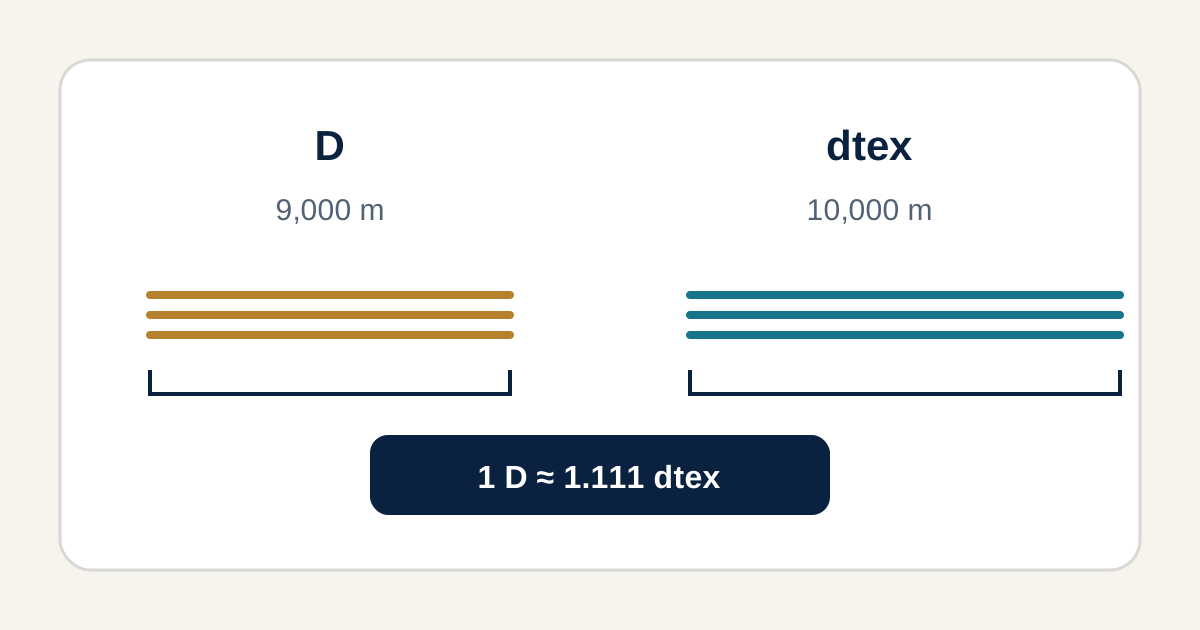
Denier and decitex are fixed-length linear-density systems. Denier expresses the mass, in grams, of 9,000 metres; dtex expresses the mass, in grams, of 10,000 metres. On either scale, a higher value describes more mass per stated length. This tells a buyer how to interpret the unit, but it does not tell the full construction, strength, elongation, surface condition, or behavior of a filament in a particular process.
The relationship follows from the two reference lengths: 1 D is approximately 1.111 dtex, and 1 dtex is 0.9 D. Coats publishes the definitions and conversion table in its thread-numbering reference. This explains how to read the measurement units; it does not authorize rewriting a supplier's product identifier or replacing the method agreed for an order.
For a worked unit example, 100 D corresponds to about 111.1 dtex when both values describe the same linear density. The result is a converted measurement, not a new catalog code: keep 100D/30F as the quoted identity, put the converted figure in a separate field, and state the rounding convention. If a quotation says 111 dtex without naming the model or conversion basis, the buyer cannot know whether it is a rounded conversion, a separate specification, or a transcription error. Resolve that ambiguity before the sample label and purchase record are created.
The units also do not carry a process recommendation. Two materials with equal linear density may differ in filament count, construction, finish, or other specification fields. A unit conversion is useful for checking that two documents speak about the same mass-per-length basis; it does not make different constructions interchangeable. Keep the unit comparison and the application decision in separate columns on the specification sheet.
See the Coats thread-numbering reference for unit definitions and conversions. Use the buyer's agreed unit and rounding convention in specifications and reports.
F is a count, not a second linear-density unit
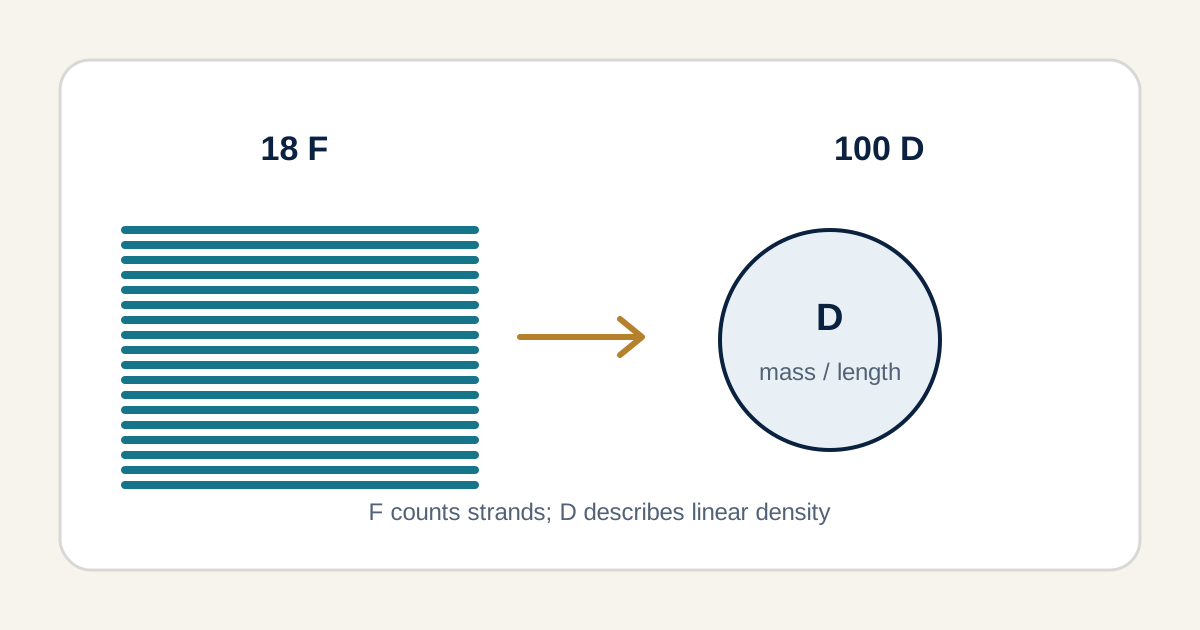
The F field in a label such as 55D/18F denotes the number of filaments represented by that construction code. It is a count, not grams per length. A change in F alone cannot be read as a change in total denier, because the complete construction and the supplier's convention still matter. Ask the supplier to confirm whether the leading D value describes the complete filament yarn or another defined component whenever that point is not stated in the specification.
Filament count can help identify the construction being discussed, but it does not independently tell you filament uniformity, cross-section, finish, twist, tenacity, elongation, or how evenly a load is shared. Those are separate properties and need their own definitions and methods if they matter to the application. A purchase request that says only “18F” leaves the linear-density field and acceptance method unresolved.
A useful arithmetic check is possible only after the supplier confirms that D is the total linear density of the bundle. On that explicit assumption, 100D/30F gives an average of 100 ÷ 30 = 3.33D per filament; 200D/60F gives the same arithmetic average. This does not prove that every filament is identical or that the two yarns behave alike. It is a way to read a confirmed notation, not a test result or a substitute for a written construction specification.
Compare models only after matching the construction
A useful comparison begins by putting the same information on both sides of the table. Match the product family, the unit system, the construction format, and the process grade being discussed. The Three Thai catalog separates its PVA filament into standard, high-shrinkage, and colored groups; those labels are not interchangeable, and a model from one group should not be substituted for another simply because one number looks similar.
| Field | What to record | Why it matters |
|---|---|---|
| Model identifier | Copy the complete D/F or T/F notation exactly | Prevents a partial code from being treated as the same construction |
| Unit convention | State denier, dtex, or the supplier's written basis | Prevents an unlabelled number from being mistaken for a direct match |
| Product group | Standard, high-shrinkage, or colored as listed | Keeps distinct product options separate |
| Package and test | Record the supplied package and the buyer's trial method | Connects the quotation to the material and process actually evaluated |
Do not sort models by the final digits alone or compare D and T as though the letters named the same unit. If a specification changes a unit or notation, keep the original code and the proposed interpretation side by side until both parties confirm the mapping in writing. When a supplier's published label leaves an ambiguity, ask for the underlying specification rather than resolving it by assumption.
Turn the code into a testable sample brief
A sample request should name the complete catalog identifier and the job the filament must perform. Include the machine route, where the strand enters the construction, the conditions it must withstand before removal, and the stage at which the buyer needs it to leave. State which observations will decide the trial: for example, stable feeding, the required temporary support, a defined removal endpoint, or a finished-fabric check. Those are distinct questions; one successful observation does not answer all of them.
| Field | Example entry | Boundary |
|---|---|---|
| Requested model | 100D/30F, standard group | Use only if this is the current agreed catalog model |
| Unit question | Does 100D describe the complete bundle? | Supplier confirms the definition in writing |
| Calculation | If yes: 100 ÷ 30 = 3.33D average per filament | Arithmetic average; not proof of equal individual filaments |
| Trial decision | Feed path, removal endpoint, finished construction | Agree each acceptance method separately |
Treat the table as a discussion template, not as a purchase approval. A buyer can fill the model and machine fields from a real project, then ask the supplier to complete the construction definition and current specification revision. If the response changes the notation, retain both versions and request a written mapping; do not erase the original entry after making a conversion. This small recordkeeping step prevents a converted unit from being mistaken for a different physical model later in sampling, testing, or repeat ordering.
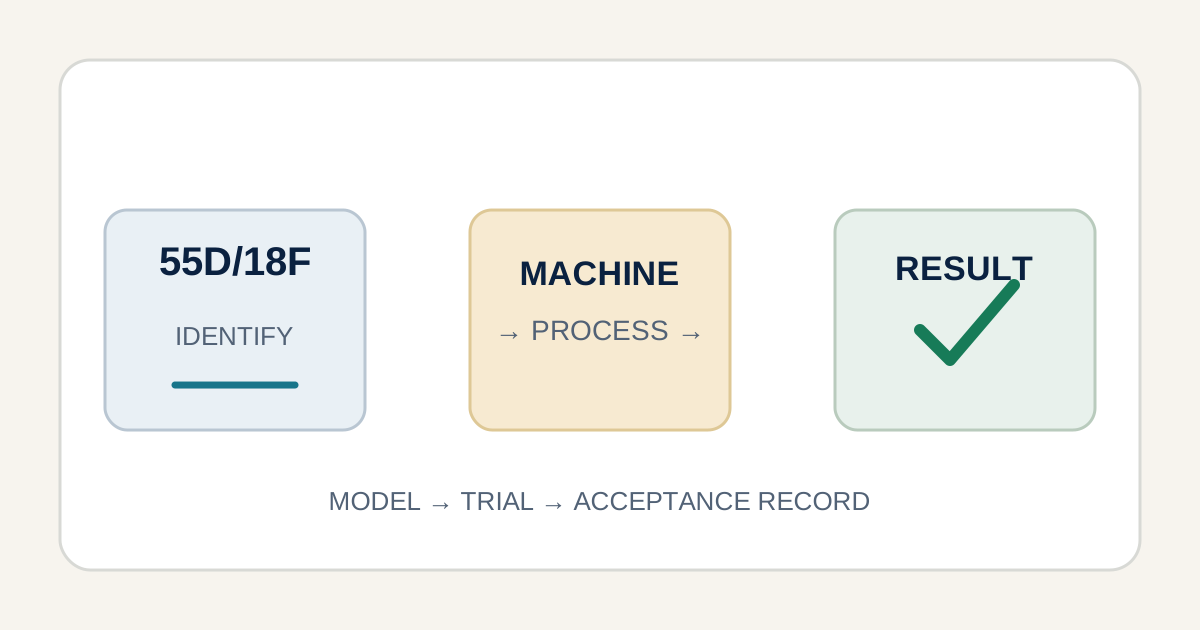
- Write the complete model code, including D or T and F, exactly as quoted.
- State the material group and any written specification or revision used for the sample.
- Describe the machine, guide path, tension controls, and the construction that will carry the strand.
- List the thermal and wet stages before removal, including the order of operations.
- Define the acceptance endpoint and keep the method, specimen identity, and observations with the result.
The buyer specification checklist covers the broader purchase brief, while the sample-to-production testing guide shows how to carry a candidate from a controlled trial into a production decision. Use the sample request route to send the construction and process conditions together.
Measure only what the decision requires
If the decision depends on mass per length, agree how the sample will be prepared, conditioned, and measured before comparing results. Choose a written method that fits the sample and the question; results from different specimen preparation or conditioning histories may not be comparable. Check that the laboratory procedure defines the sample basis, calculation, and measurement conditions before treating a number as an acceptance result.
Keep unit, method, conditioning, instrument or balance identification, sample length or skein basis, and calculation with each result. Do not infer filament count from a mass-per-length result, or infer denier from a photograph. If values differ, first check that the same unit and method were used, then review sample identity and test preparation. Record a deviation as an observation; investigate the cause through a controlled comparison rather than assigning it to the model code alone.
When a result is close to an agreed limit, preserve the original readings and calculation instead of rounding each value early. Compare like-for-like specimens and record whether the displayed result is a single reading or a summary of several measurements. The buyer and supplier should decide in advance how repeat readings, rounding, and an out-of-range result are handled. This avoids settling a dispute by changing the number of decimal places after the measurement has been seen.
Before comparing mass-per-length results, put the agreed sample preparation, conditioning, calculation, and acceptance method on the buyer's written test plan.
Avoid four common specification errors
- Dropping F from a model code and then assuming two samples have the same filament construction.
- Copying a D value into a dtex field without labeling the conversion or preserving the original identifier.
- Treating a higher F count as proof of higher strength, finer yarn, better uniformity, or easier removal.
- Approving a material from its code alone without checking the machine route and the required process endpoint.
The correction is a small but important discipline: retain the supplier's code, state what each field means, and tie the model to the sample and test record that was actually reviewed. If a buyer and supplier use different notation, write down the agreed mapping before the quotation, label, or order is revised. That preserves traceability without implying that the catalog value predicts every process result.
Frequently asked questions
What does D mean in a PVA filament code?
D denotes denier, a linear-density unit based on the mass in grams of 9,000 metres. Check the supplier's specification for the exact construction represented by the value, then keep that written definition with the sample record.
What does F mean in 55D/18F?
F denotes the filament count in the model notation. It is a count and should be read separately from the D or T linear-density field; it does not state strength, elongation, or removal performance.
Can I replace D with dtex on a purchase order?
Only when the unit, conversion, rounding convention, and model mapping are agreed in writing. Keep the original catalog identifier visible so the sample and order remain traceable, and do not let a converted value silently replace the supplier's model code.
Does the filament code prove that a sample will work on my machine?
No. The code identifies a listed construction. Feeding, support, removal, and finished-product acceptance need trials on the relevant machine and process route, with the acceptance endpoint agreed before the trial begins.