
Technical guide · Technical Resources
Embroidery Lace Support Trial: Thread, Ground and Pattern Geometry
Choose embroidery-lace support by its structural job and exit route. Map the motif, bridges, edges, openings, retained stitches and support path before choosing soluble thread or removable ground. Thread can stabilize a stitch or partner locally; ground supports a wider area. Approve only after the pattern stays intact through removal and drying.

Choose support for the geometry that must remain
Choose embroidery-lace support by its structural job and exit route. Map the motif, bridges, edges, openings, retained stitches and support path before choosing soluble thread or removable ground. Thread can stabilize a stitch or partner locally; ground supports a wider area. Approve only after the pattern stays intact through removal and drying.
Success means intended geometry and retained threads remain acceptable after support leaves, not simply that a strand dissolves. List thread, ground and permanent embroidery roles separately.
Map the stitched geometry before selecting material
Use a production file or marked swatch to map the repeat, outlines, narrow bridges, open windows, joining points and dense stitch areas. Trace the temporary support path and permanent attachments. One path may carry tension across several motifs, so a local change can affect the wider repeat.
Mark the most delicate feature and a stable area. Identify pattern lines, joining links and anchored ends; photograph both faces with orientation marks. Reuse these inspection points to distinguish intended openings from broken bridges.
Separate permanent threads from temporary support
List face thread, backing or bobbin thread, temporary partner thread, and ground separately. State what remains in the lace. A temporary thread can pair with another stitch; a soluble base can carry the embroidery; some designs use both. Names alone do not show placement, load path or removal method.
Check the removal route against retained yarns, dyes, finishes and any ground intended to stay. If thread and base both leave, order may matter. A process that removes thread cannot be assumed to remove a permanent ground. Label the target for each endpoint.
Decision table: match support form to lace geometry
Match the support form to the structure it must hold, not just its general solubility label.

| Support form | Possible geometry role | Map and evaluate |
|---|---|---|
| Temporary support thread | Stabilize a stitch path or partner thread locally | Path, attachment stitches, bridge and thread ends |
| Water-soluble ground fabric | Carry or dimensionally support a broader motif field | Motif repeat, open areas, edge and post-removal size |
| PVA-based nonwoven ground | Support embroidered motifs as a sheet-like base | Area coverage, stitch skips, shrinkage and wash access |
| Combined thread and ground | Hold separate parts of the structure during embroidery | Removal order, retained yarns and interaction between supports |
Pass only if the support works during embroidery and the permanent pattern meets the buyer’s criteria after removal.
Use patent examples within their stated scope
A double-embroidered lace patent distinguishes a soluble or insoluble ground from an insoluble backing thread used to secure the embroidery. Ground solubility alone does not identify thread removal. See US5111760A.
A separate patent describes temporary pairing of soluble and retained threads in an embroidered medical structure. Its example mentions acetate, not a PVA apparel-lace product. See US20100089297A1 only as a construction example, not proof that PVA sewing thread behaves the same way in apparel lace.
Treat both patents as construction examples, not specifications. Verify the support form and removal behavior in the target embroidery.
Treat a backing web as a separate support system
A ground supports a wider region than a thread and can affect registration and dimensions. A chemical-lace patent describes dyed embroidery yarn on a nonwoven web of water-soluble PVA-based fiber with a PVA-based binder. This is backing fabric, not thread. See
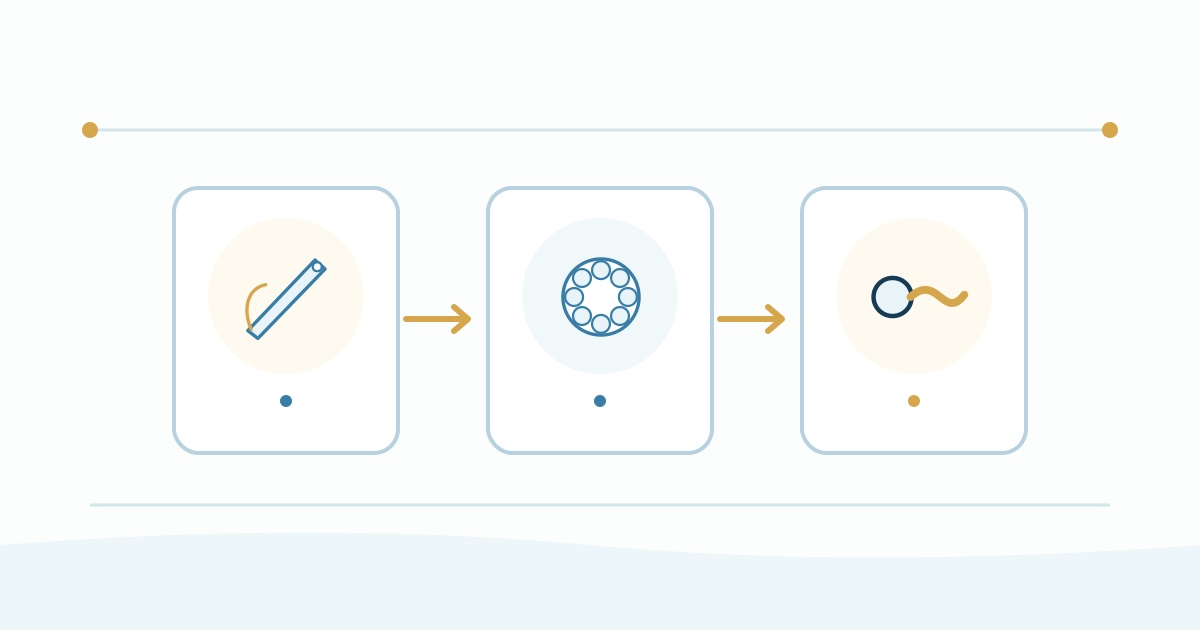
EP1862585A1, then identify the ground and embroidery layers in your design.
Trial whether the ground holds motif position and whether removal changes openings, edges or dimensions. A cup test does not reproduce stitch coverage, binder, dyes or restraint. Do not substitute thread data for web data.
Protect bridges, edges and open windows
Challenge the narrowest bridge, outer border, junction and densest stitch area. Check that support does not shift retained thread as it softens or leaves. Verify open windows and mark outlines for each layer before testing.
Inspect flat and during relevant handling. Compare repeat, edge alignment and retained ends with a reference. Visual checks can reveal skipped stitches, broken links or distortion, but cannot prove chemical removal.
Run the removal trial on the full embroidered structure
- Stitch a representative motif with the actual density, ground, support and retained yarns.
- Record setup and support path; mark fragile bridges, edges and openings.
- Run the planned removal and drying route; record order and conditions.
- Inspect both faces, geometry, retained stitches, color and residue.
A loose-thread test does not reproduce stitch locks, dense intersections, binder or ground fabric. Set the endpoint on the actual construction; add analysis if buyer criteria require it.
Diagnose failure by its location
If motifs shift, review support path, attachment stitches and ground restraint. If bridges open or ends release, inspect stitch plan and timing of support weakening. For residue, check dense intersections, binder or finish. Confirm which component the process was meant to remove.
Change one variable at a time and retain the failed swatch with its map. Do not automatically intensify removal; that may affect retained yarns, dyes, dimensions or hand. Test one specific correction next.
Trial record and sample request
| Record item | What to capture | Decision it supports |
|---|---|---|
| Geometry | Motif, repeat, bridges, edges and openings | Identifies retained features |
| Materials | Face, backing, temporary thread, ground and finish | Separates removable and retained parts |
| Process | Machine setup, path, order and conditions | Supports repeatability |
| Outcome | Residue, retained threads, color and shape | Links approval to finished lace |
Review the embroidery and sewing application for context, compare the water-soluble PVA sewing thread or PVA yarn form with the support role, and send pattern, ground and criteria in a sample request. The recorded trial must establish fit for this design.
Embroidery-lace support questions
Can a backing film be replaced with a soluble thread?
No. A film or web supports an area; thread may support a stitch or thread pair. Compare placement, load path and endpoint in the pattern.
Does a patent on soluble embroidery thread prove PVA suitability?
No. Examples may use another material and structure. Test the exact PVA candidate with retained yarns and finishes.
What part of the lace should the trial challenge?
Include a narrow bridge, edge, dense junction and open window to reveal shifting or unintended openings.
How can a mill tell whether the ground or thread remains?
Map each support component and inspect it at the endpoint. Add analysis if visual inspection cannot meet the buyer’s residual requirement.